The Studio as Trophy: How the Creative Workspace Became America's Most Coveted Status Symbol
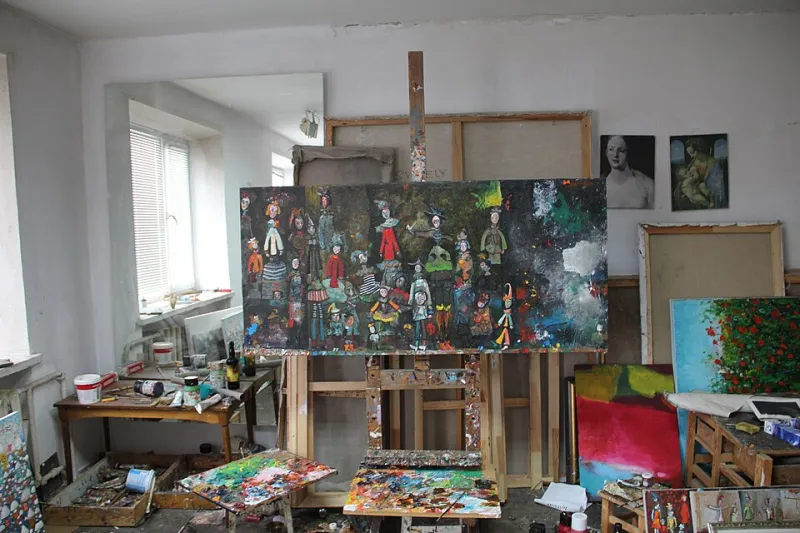
Photo: Temo Svirely, CC BY-SA 4.0, via Wikimedia Commons
The Room That Tells the Story
There is a particular kind of photograph circulating on Instagram right now. It features exposed brick or poured concrete, a north-facing skylight casting flat, cinematic light across a worktable dusted with pigment or clay. A half-finished canvas leans against the wall. A shelf of art books — spines facing out, naturally — anchors the composition. The caption, almost always, is modest. The space. Back at it. Sunday mornings.
What is being sold here is not art. It is the idea of making it.
Across American cities and their increasingly expensive suburbs, the dedicated creative studio has emerged as one of the most potent symbols of cultural capital in the contemporary luxury landscape. It has displaced the home gym, outpaced the chef's kitchen, and — perhaps most tellingly — begun to rival the gallery wall as the preferred backdrop for projecting a certain kind of sophisticated, intentional life. The studio is no longer simply where work happens. It is where identity is performed.
From Amenity to Architecture
For decades, the creative workspace was understood as a concession — a room surrendered to mess, a garage tolerated for its utility. Even in the most design-forward homes, studios occupied the margins: the basement corner, the converted spare bedroom, the garden shed. They were functional, not aspirational.
That calculus has shifted dramatically. High-end real estate listings in cities like New York, Los Angeles, and Chicago now routinely feature dedicated studio spaces as primary selling points, complete with professional-grade lighting systems, custom storage for archival materials, and ventilation infrastructure suited to oil-based media. In new construction, architects are being commissioned to design studios with the same programmatic rigor previously reserved for home theaters or wine cellars. The language has changed, too: these are no longer "hobby rooms." They are ateliers, creative suites, maker's sanctuaries.
The shift reflects something more than real estate trend-chasing. It signals a reordering of values — a cultural moment in which visible creative labor has become a marker of authenticity that money alone can no longer purchase. You can buy a Basquiat. You cannot buy the story of having made something with your own hands. The studio is the room that tells that story.
The Instagram-ification of Making
It would be disingenuous to examine this trend without acknowledging the role of social media in reshaping what a studio is supposed to look like — and who it is supposed to impress. The platforms have not merely documented the rise of the aspirational creative space; they have actively designed it.
The most-shared studios on Instagram share a visual grammar so consistent it borders on parody: natural materials, analog tools, a conspicuous absence of clutter (despite the ostensible chaos of making), and an overall aesthetic that suggests both productivity and ease. This is not the studio of Francis Bacon, with its magnificent disorder and its floors archaeology of creative process. This is the studio as editorial set — curated, controlled, and optimized for a particular kind of engagement.
For some practitioners, this tension is genuinely troubling. The studio, historically, has been a space defined by its privacy — a room where failure was permitted, where process was protected from public scrutiny. The Instagram studio inverts that logic entirely. It makes the workspace into a stage, the artist into a character, and the act of making into content. The authenticity being signaled is, in a sense, manufactured.
And yet the demand for that signal is real, and growing.
Collectors, Creatives, and the New Cultural Economy
Perhaps the most interesting dimension of this trend is the way it has blurred the line between collector and creator. Wealthy art patrons — a demographic that has historically defined itself through acquisition rather than production — are increasingly investing in studios of their own. Some take up painting or sculpture as genuine practice. Others commission spaces that function more as private residences for visiting artists, creative salons, or simply rooms designed to evoke the atmosphere of making without the inconvenience of the process itself.
This phenomenon speaks to a broader cultural anxiety about passive consumption. In an economy increasingly dominated by digital experience, the physical act of creation — the resistance of clay, the smell of linseed oil, the irreversibility of a mark on paper — has taken on an almost talismanic quality. The studio is not just a workspace. It is a rebuttal to the screen.
For creative professionals, meanwhile, the dedicated studio has become a legitimate business investment, a professional necessity, and a personal sanctuary in roughly equal measure. As remote work has dissolved the boundary between living space and workspace, the deliberate creation of a room devoted entirely to creative labor has become an act of self-definition. To have a studio is to insist, architecturally, that what you do matters enough to deserve its own room.
What the Trend Reveals
The rise of the studio as status symbol is, at its core, a story about what Americans currently believe creativity is worth — and what it costs to perform it convincingly. It reflects a culture navigating genuine tensions: between authenticity and curation, between making and marketing, between the private necessity of creative work and its increasing public legibility as a lifestyle.
There is something both aspirational and melancholy in that navigation. The studios being built and photographed and coveted across the country are, in many cases, genuinely beautiful spaces. They honor the idea of creative labor in ways that previous generations of home design largely ignored. But the question of whether they honor the practice itself — or merely its aesthetic — remains productively open.
The most honest answer is probably that they do both, imperfectly and simultaneously. Which is, come to think of it, a fairly accurate description of how most creative work actually gets made.