Objects Without Origins: The Collectors Who Have Fallen in Love With the Blank Provenance
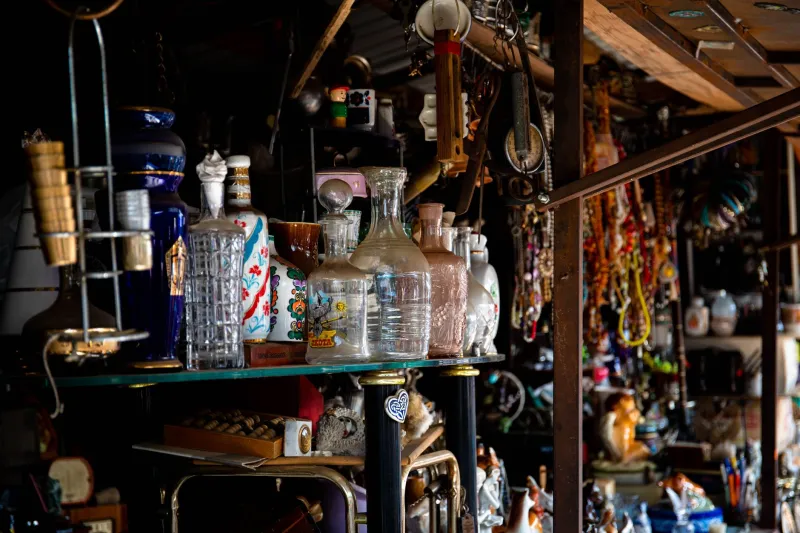
Somewhere in a Los Angeles estate sale, on a folding table between a box of Reader's Digest condensed novels and a set of discontinued flatware, sits a small ceramic vessel. It is roughly eight inches tall. The glaze is a deep, uneven celadon that pools darker at the base. There is no mark on the bottom—no maker's stamp, no country of origin, no date. The estate sale company has priced it at twelve dollars. A collector picks it up, turns it slowly in both hands, and sets it back down. Then picks it up again.
What happens next is the subject of a quiet but significant shift in American collecting culture.
The Provenance Industrial Complex
For most of the twentieth century, the market for antiques, vintage design, and decorative objects operated on a principle that seemed self-evident: documentation was value. The object that arrived with a clear record of its making—a named designer, a manufacturing date, an exhibition history, a chain of ownership leading back to some distinguished original source—commanded a premium over the object that could not account for itself. Provenance was the object's biography, and biography, the market believed, was what transformed a thing into a collectible.
This belief generated an entire infrastructure: authentication services, scholarly catalogs, certificates of origin, the elaborate apparatus of the auction house with its condition reports and lot notes. The story of the object was as important as the object itself, and in some cases more so. A piece of mid-century furniture by a celebrated designer could command ten times the price of a formally identical piece by an unknown maker, not because the materials or craftsmanship differed, but because one had a name attached and the other did not.
That infrastructure has not disappeared. But its cultural authority is being contested, and the contest is coming from an unexpected direction.
The Appeal of the Unnamed
A growing cohort of collectors—concentrated among younger buyers, but by no means limited to them—has begun to express a preference that runs precisely counter to the provenance premium. They are seeking objects without documentation. Not objects whose documentation has been lost or obscured, but objects for which the absence of origin story is itself the condition of their appeal.
The reasons are multiple and, taken together, constitute something like a philosophy of collecting.
The most frequently cited is the freedom the anonymous object affords. An attributed piece arrives weighted with its own history—with the designer's biography, the period's aesthetic associations, the collector's obligation to understand the object within its established context. The unattributed piece asks none of this. It exists in a kind of temporal suspension, readable in any number of ways, available to be understood on the terms the collector brings to it rather than the terms the market has already assigned.
This is, in a sense, the collecting equivalent of the unmarked wine in a blind tasting—an encounter with the object itself, stripped of the contextual cues that would otherwise determine how it is experienced. And like the blind tasting, it frequently produces surprising results. Objects that the market has not yet assigned a value to are often, it turns out, extraordinary.
The Flea Market as Gallery
The spaces where anonymous objects are found have undergone a corresponding cultural reappraisal. The estate sale, the flea market, the rural antique barn, the Goodwill outlet—venues that were once considered the domain of bargain hunters and resellers—are now frequented by collectors who would be entirely comfortable at a Christie's preview but choose, for specific acquisitions, to go elsewhere.
What these spaces offer is not merely lower prices, though that is not irrelevant. They offer the possibility of genuine discovery—of encountering an object that no one has yet told you how to feel about. In a market where the celebrated objects have been so thoroughly discussed, priced, and contextualized that acquiring them feels less like collecting and more like executing a known transaction, the undocumented piece represents a frontier.
Several interior designers working at the upper end of the American residential market have noted a marked shift in how their clients approach the furnishing of significant rooms. Where a client might once have specified a particular manufacturer or period, they now arrive with photographs taken at flea markets, images of objects found in storage units, references to things glimpsed at estate sales in unfashionable zip codes. The object's anonymity is not a problem to be solved before the acquisition—it is the reason for it.
What the Blank Provenance Permits
There is a design argument here that extends beyond the collector's psychology into the practical life of objects in rooms. The documented piece, particularly in the area of twentieth-century design, often carries with it a set of received associations that can be difficult to escape. To place a celebrated mid-century chair in a contemporary room is to invoke the entire aesthetic conversation surrounding that chair—the period, the designer's other work, the rooms in which the object has been photographed before. The object has a visual history that precedes it into every space it enters.
The anonymous piece has no such history. It arrives without associations, without the aesthetic baggage of its previous interpretations. This makes it, paradoxically, more flexible—more capable of becoming what the current room needs it to be rather than insisting on what it has always been understood to represent.
For designers working to construct interiors that feel genuinely singular rather than assembled from a catalog of established references, this flexibility is not a minor convenience. It is a primary tool.
The Ethics of the Unmarked Object
It would be incomplete not to acknowledge the complications embedded in the romance of the unattributed object. Provenance systems, for all their market distortions, also serve legitimate functions—including the identification of looted cultural property, the attribution of credit to makers who have been historically overlooked, and the preservation of craft traditions that survive only through documentation.
The collector who celebrates blank provenance should perhaps sit with the question of what that blankness sometimes conceals. Not every unknown object is innocent of history—some are undocumented precisely because their documentation would be inconvenient. The pleasure of the anonymous find does not entirely excuse the responsibility to ask why the object cannot account for itself.
The Object That Asks Nothing
And yet the deeper impulse driving this shift seems genuine and worth taking seriously. We live in a moment of relentless contextualization—in which every object, every experience, every aesthetic choice arrives pre-interpreted, its significance explained before it can be felt. The collecting culture that has grown up around branded heritage and documented provenance participates in this condition: it tells you what to think about the object before you have had a chance to think anything at all.
The anonymous object refuses that pre-interpretation. It stands before the collector without credentials, without the endorsement of the market, without the protective armor of a famous name. It asks only to be looked at—carefully, without reference, on its own terms.
That, in a cultural moment exhausted by the explained and the attributed, may be the most radical thing an object can do.