Closed Doors, Open Minds: The Quiet Revolt Against the Collaborative Workspace
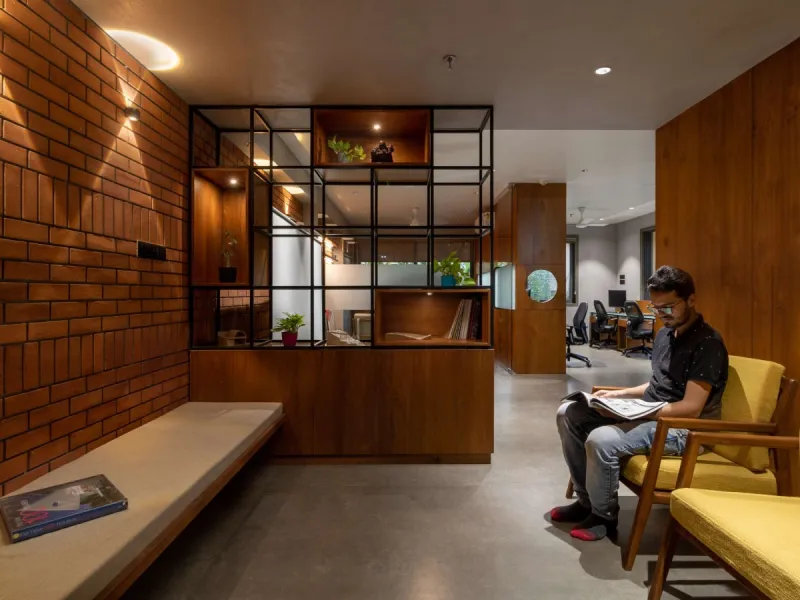
Photo: private studio workspace closed door solitary designer thinking, via volzero.com
There is a particular kind of silence that a designer learns to mourn. Not the silence of absence, but the silence of depth—the productive, almost pressurized quiet that precedes a genuine idea. It is the silence that open-plan offices, collaborative studios, and so-called creative hubs have been systematically dismantling for the better part of two decades, all in the name of innovation.
The irony is not lost on those who built these spaces. The same industry that prides itself on problem-solving designed a working environment that may be one of the most persistent obstacles to original thought ever constructed.
The Architecture of Distraction
The open-plan office arrived in America with the credibility of Silicon Valley behind it. Google's campuses, with their ping-pong tables and unobstructed sight lines, became the aspirational template for every startup, agency, and creative firm that wanted to signal dynamism. Walls came down. Partitions were dismantled. The private office—once a marker of professional achievement—was recast as a symbol of hierarchy, insularity, and creative stagnation.
What replaced it was a landscape of perpetual low-grade interruption. Research from the University of California, Irvine, has consistently found that it takes an average of twenty-three minutes to fully regain concentration after a workplace disruption. In an open studio environment, where ambient conversation, movement, and the auditory residue of other people's phone calls form a near-constant backdrop, that recovery window may never fully close.
For designers and artists—whose work demands sustained engagement with complex, often abstract problems—this is not a minor inconvenience. It is a structural impediment.
"I was producing more technically," says one Brooklyn-based graphic designer who spent three years at a celebrated shared creative studio in Dumbo before renting a small, private room in a converted warehouse in Bushwick. "But I wasn't producing anything I was proud of. There's a difference between output and thought. The open studio was great for output."
Solitude Has a History
The romantic image of the isolated artist—working alone in a sparse studio, hermetically sealed from the noise of the world—is often dismissed as mythology, a convenient fiction that obscures the fundamentally social nature of creative culture. And it is true that movements are born from collision: the Abstract Expressionists gathered at the Cedar Tavern; the Bauhaus was, at its core, a community.
But what is frequently overlooked is that those communities were not structured around constant, enforced proximity. The Cedar Tavern was a place of deliberate gathering, not a permanent condition. The Bauhaus masters had studios. The collision happened at the margins of solitude, not in its absence.
Historically, the most transformative creative work has emerged from a rhythm—periods of deep, private concentration punctuated by intentional social exchange. Darwin had his thinking path. Proust had his cork-lined room. Frank Lloyd Wright, for all his theatricality, designed Taliesin as a compound that allowed for withdrawal as readily as it encouraged congregation.
The open-plan model, by contrast, collapses that rhythm into a single, undifferentiated frequency. It is always the tavern. It is never the studio.
The Neuroscience of the Closed Door
Cognitive science has grown increasingly articulate about what solitude does for the creative brain. Research into what psychologists call the "default mode network"—the neural circuitry that activates during periods of rest, daydreaming, and inward attention—suggests that this state is far from passive. It is, in fact, the state in which the brain consolidates information, draws unexpected connections, and generates the kind of non-linear insight that constitutes genuine creative thought.
Open environments suppress the default mode network almost by design. The brain, wired for threat detection and social responsiveness, cannot easily enter a state of reflective depth when it is continuously processing ambient social information. Every passing conversation, every glance across a shared table, every notification ping is a small neurological interruption—a signal that demands the brain's attention and pulls it away from the slow, associative work of original thinking.
This is not an argument against collaboration. It is an argument for its proper architecture.
"Collaboration is most productive when it happens between people who have already done their thinking," notes a Los Angeles-based interior designer who has spent the last several years redesigning creative workplaces for mid-size agencies. "When you put people together before they've had a chance to develop their own ideas, you don't get synthesis. You get the loudest voice in the room."
The Retreat, Reconsidered
A counter-movement is emerging, quiet but unmistakable. Across American cities, designers, architects, and artists are making deliberate spatial choices that prioritize enclosure—not as a rejection of community, but as a precondition for meaningful participation in it.
In Chicago, a collective of independent architects recently converted a former printing facility into a workspace organized around a series of small, private studios that ring a central communal area. The model is deliberately hybrid: solitude is the default; sociality is the choice. Members describe the arrangement as transformative, not for the private studios alone, but for the quality of the conversations that happen in the shared space—conversations between people who have actually had time to think.
In New York, a handful of design firms have quietly reversed open-plan renovations completed less than a decade ago, reinstalling walls and restoring private offices after noting measurable declines in the quality of conceptual work. These reversals rarely generate press releases. The open plan was announced; its failure is absorbed in silence.
The design community's relationship with closure is, perhaps inevitably, complicated by its own cultural politics. To advocate for private space risks appearing elitist, retrograde, or indifferent to the genuine value of inclusive, accessible work environments. The open plan carried a democratic promise—that the junior designer and the creative director would inhabit the same spatial register, that hierarchy would dissolve in the absence of walls.
But democracy of space is not the same as equity of thought. And a workspace that prevents deep thinking does not serve anyone, regardless of where they sit.
What the Walls Were Holding
There is something worth recovering in the idea of the closed door—not as a barrier, but as a frame. A room that contains you also concentrates you. It makes the work feel serious, bounded, and worth protecting. It communicates, even in its architecture, that what happens inside it matters.
The best creative spaces have always understood this. They have known that the quality of what emerges from a studio is inseparable from the quality of the conditions inside it—that light, scale, acoustic texture, and the simple fact of enclosure are not merely aesthetic preferences but cognitive infrastructure.
The open plan promised to democratize creativity by eliminating those conditions. What it delivered, in many cases, was the appearance of creative energy without its substance: the performance of collaboration mistaken for the thing itself.
The door, it turns out, was not the problem. In many cases, it was the solution—and we spent twenty years taking it off its hinges.