Breathing Rooms: How the Japanese Philosophy of Ma Is Quietly Transforming the American Home
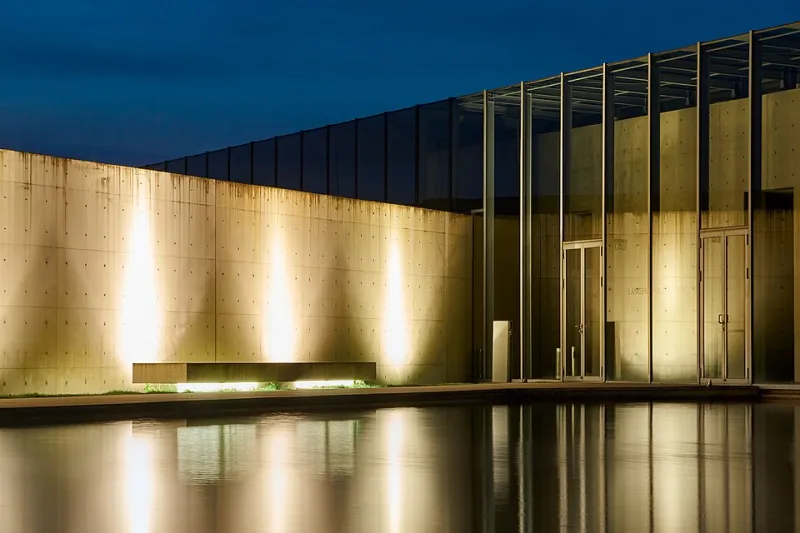
Photo: Anil Öztas, CC BY-SA 4.0, via Wikimedia Commons
There is a particular quality of stillness that settles over a room when it has been designed with genuine restraint. Not emptiness — emptiness is passive, even melancholy — but a charged, intentional openness that seems to breathe alongside its inhabitants. This is, in essence, the spirit of ma: a Japanese spatial concept that has no clean English translation, though architects across the United States are increasingly finding ways to speak its language in wood, glass, and concrete.
At its most elemental, ma (間) describes the meaningful pause between things — the silence between musical notes, the threshold between indoors and out, the interval of air between a wall and a piece of furniture. It is a philosophy that treats negative space not as absence but as presence, not as leftover but as load-bearing in its own quiet way. And in a cultural moment defined by digital saturation, overcrowded schedules, and the psychic weight of accumulation, its appeal to American sensibilities feels less like trend and more like remedy.
From Kyoto to California: A Philosophy Finds New Ground
The influence of Japanese aesthetics on Western design is hardly new — the Arts and Crafts movement drew from it, mid-century modernism absorbed it, and figures like Frank Lloyd Wright famously channeled Japanese spatial logic into the American prairie house. But what practitioners describe today is something more nuanced than aesthetic borrowing. It is a philosophical recalibration.
Architects working across cities like Portland, Los Angeles, and Brooklyn are reporting a marked shift in client conversations. Where homeowners once arrived with Pinterest boards dense with fixtures and finishes, many are now asking something more elusive: How do I make a space feel like it can breathe? That question, deceptively simple, opens directly onto the principles of ma.
The concept operates on multiple registers simultaneously. Spatially, it asks designers to resist the impulse to fill — to honor the interval between a kitchen island and a window, to allow a hallway to widen into a moment of pause before entering a room. Materially, it gravitates toward natural surfaces that age with dignity: raw linen, oiled oak, unglazed ceramic. And architecturally, it demands a serious engagement with airflow, light migration, and the way a structure responds to its surrounding climate throughout the day.
Wind as Design Element
Perhaps the most compelling — and least discussed — dimension of Japanese architectural influence on American homes is the treatment of wind and air movement as genuine design materials. Traditional Japanese residential architecture, particularly in the sukiya and minka traditions, was engineered around the idea that a home should participate in its natural environment rather than insulate against it. Sliding shoji screens, open engawa corridors, and strategically positioned apertures were not merely aesthetic choices; they were passive climate-management systems that invited seasonal breezes to move through interior spaces in deliberate patterns.
Contemporary American architects working in this lineage are adapting these principles to local climates with considerable ingenuity. In the Pacific Northwest, firms are designing homes with operable clerestory windows positioned to draw cool air upward through a stack-effect system, eliminating the need for mechanical cooling during mild months. In the Southwest, courtyards modeled loosely on the Japanese tsuboniwa — an intimate enclosed garden — create microclimates that moderate temperature and channel prevailing winds into adjacent living spaces.
This wind-responsive approach is gaining traction not only for its sensory qualities but for its alignment with sustainability imperatives. As energy efficiency standards tighten and climate anxiety deepens, the idea that a home might be designed to work with atmospheric conditions rather than against them carries both practical and philosophical weight.
The Wellness Dimension
It would be reductive to frame the American appetite for ma purely as an aesthetic preference. There is a wellness dimension to this shift that deserves serious consideration. Research in environmental psychology has consistently demonstrated that spatial density, visual clutter, and limited access to natural light and air contribute measurably to elevated stress levels and diminished cognitive performance. The designed environment, in other words, is not neutral — it acts upon its inhabitants, shaping mood, attention, and physical wellbeing in ways that are only beginning to be fully understood.
Japanese spatial philosophy has long operated from an intuitive understanding of this relationship. The ma between objects is not decorative; it is functional in the deepest sense, allowing the eye and mind to rest, to locate themselves, to breathe. When American homeowners describe feeling "calmer" or "more themselves" in spaces designed around these principles, they are articulating something that transcends style preference. They are describing a physiological response to a built environment that has been designed with their nervous systems in mind.
Authenticity Over Imitation
Practitioners are quick to caution against the kind of superficial cultural borrowing that reduces a rich philosophical tradition to a visual aesthetic. Incorporating ma into American residential design is not a matter of installing shoji screens or sourcing Japanese ceramics, though both may find their place. It is a matter of absorbing the underlying logic — the discipline of restraint, the respect for interval, the attentiveness to how air and light move — and applying it with sensitivity to local context, climate, and the particular lives being lived within a given space.
The most compelling examples of this cross-cultural design dialogue are those that feel neither imitative nor apologetic. They are homes that have arrived at their own quiet authority — spaces that seem, somehow, to know themselves. In them, the influence of ma is not visible so much as felt: in the unhurried quality of a morning light crossing an unadorned wall, in the sound of wind moving through a carefully positioned window, in the simple, sustaining pleasure of a room that has been given room to breathe.
In a nation historically inclined toward more — more square footage, more amenities, more visual stimulation — that kind of architectural restraint represents a genuinely radical proposition. And increasingly, Americans appear ready to receive it.