The Loudest Room in the House Is Empty: How Restraint Became the New Excess
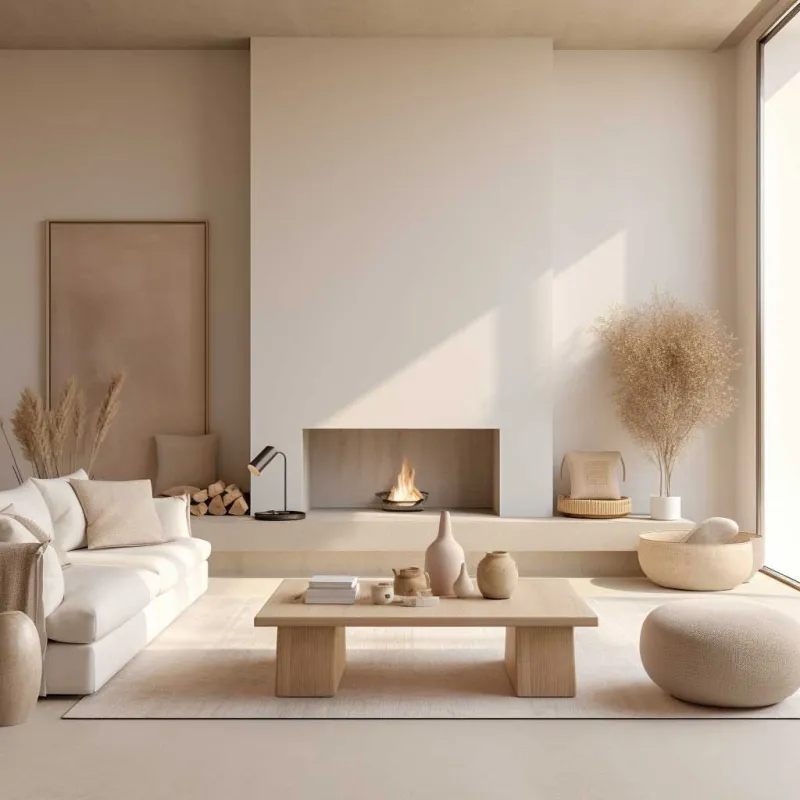
Photo: minimalist beige interior design luxury empty room neutral palette, via artfasad.com
There is a particular shade of beige — warm, slightly dusty, expensive in the way that only things without price tags manage to appear — that has colonized the American interior. It lives on the walls of renovated brownstones in Brooklyn and newly constructed wellness retreats in Scottsdale. It appears on the Instagram grids of interior designers who describe their work as "considered" and "intentional," two words that have quietly become the luxury sector's most reliable euphemisms for costly. This beige does not whisper. It announces itself through its very silence, and in doing so, it has become one of the most precisely engineered status symbols of our cultural moment.
The tyranny is not accidental. It was built, marketed, and sold to us with extraordinary precision.
The Grammar of Omission
Minimalism, as an aesthetic philosophy, has a genuinely radical history. From the Bauhaus workshops of 1920s Germany to Donald Judd's stripped-down sculptures at Marfa, Texas, the reduction of form was once a confrontational act — a refusal of bourgeois ornament, a demand that objects justify their existence. What we practice today under the same label bears almost no intellectual resemblance to that tradition. Contemporary "quiet luxury" is not a rejection of excess. It is excess wearing a different costume.
Consider the economics. A linen sofa in an undyed, natural tone from a brand whose website uses only lowercase lettering can retail for four times the price of an identically constructed piece in a bolder color from a conventional furniture retailer. The neutral is not cheaper to produce. The restraint is the markup. Brands have effectively monetized the act of omission, charging a premium for what they have chosen not to do — no pattern, no contrast, no visible logo — and training consumers to read that absence as sophistication.
This is a remarkable feat of cultural engineering. The market has persuaded a significant segment of American consumers that the highest form of taste is the taste that appears to require no effort, and then charged handsomely for the effort required to produce that appearance.
Quiet as a Class Signal
The sociologist Thorstein Veblen identified conspicuous consumption in 1899 as the mechanism by which the wealthy distinguished themselves through visible expenditure. What the quiet luxury movement represents is something his framework did not fully anticipate: conspicuous restraint, the performance of not performing, as an equally potent — and arguably more exclusive — class signal.
The logic is precise. A maximalist aesthetic is, in principle, accessible. Ornamentation can be approximated at various price points. A chandelier dripping with crystals, a bold printed wallpaper, a room dense with collected objects — these things can be assembled cheaply, and they frequently are. Restraint, by contrast, is extraordinarily difficult to fake convincingly. The beige that reads as luxury requires the right texture, the right undertone, the right proportion of empty space surrounding it. It requires, above all, the confidence that comes from never having needed to prove anything through accumulation. That confidence is the actual product being sold, and it cannot be counterfeited at a discount.
This is why the aesthetic has become so potent a signal among the American upper-middle and upper classes. It operates as a kind of visual literacy test, legible only to those already inside the conversation. The uninitiated see an empty room. The initiated see a declaration.
The Industry Built on Nothing
The commercial infrastructure supporting this aesthetic is neither small nor subtle. Entire brands — Jenni Kayne, The Row, Aesop, Parachute, Flamingo Estate — have constructed identities almost entirely from the language of restraint. Their visual identities favor wide margins and negative space. Their copy favors words like "craft," "provenance," and "slow." Their retail environments, where they exist, resemble the kind of gallery spaces that make visitors afraid to touch anything, which is, of course, entirely the point.
The wellness industry has been particularly adept at this translation. The spa that offers treatments in rooms of unfinished concrete and raw wood, lit by a single candle, charges more than the spa that offers the same treatment surrounded by gold fixtures and marble. The austerity is the luxury. The discomfort of the hard surfaces is rebranded as intentionality. Consumers pay not for comfort in the conventional sense but for the experience of being in a space that has been curated to signal that comfort is beneath consideration.
Social media platforms, particularly Instagram and Pinterest, function as the distribution network for this aesthetic ideology. The algorithm rewards a certain visual coherence, and the muted palette photographs with a consistency that louder interiors resist. There is a practical reason that so many aspirational lifestyle accounts default to tones of sand, stone, and bone: they are, quite literally, more algorithmically rewarding. The aesthetic and the platform have co-evolved to reinforce each other, creating a feedback loop in which restraint appears natural because it is everywhere, and it is everywhere because it performs well.
What Gets Erased
The cultural cost of this dominance is worth examining honestly. When a single aesthetic achieves the kind of market saturation that quiet luxury currently enjoys, it does not merely reflect taste — it shapes it, and in shaping it, it marginalizes everything that falls outside its narrow parameters.
The maximalist traditions of numerous American communities — the vibrant color palettes of Latinx domestic interiors, the layered textile richness of South Asian decorating traditions, the bold chromatic confidence that has long characterized African American design sensibility — are rendered, by the dominant logic, as less sophisticated, less evolved, less desirable. This is not a neutral aesthetic judgment. It is a cultural hierarchy dressed in linen.
The "rebellion" embedded in the neutral is, on closer examination, not a rebellion at all. It is the consolidation of a particular cultural authority under the guise of having transcended the need for it. The empty room is not humble. It is, in its own way, the most territorial space imaginable — one that admits only those who already know the language.
The Space Between
None of this is to suggest that restraint is without genuine value, or that the impulse toward simplicity is always cynical. There is real intelligence in the idea that objects should be chosen carefully, that space has a quality worth protecting, that the eye benefits from moments of rest. The problem is not the aesthetic itself but the ideological freight it has been made to carry — the conflation of a particular visual preference with virtue, sophistication, and cultural authority.
The most interesting design work happening right now operates in the tension between these poles, refusing the binary of maximalist excess and minimalist performance alike. It is work that takes color seriously without treating it as compensation, that embraces ornament without surrendering intention, that understands restraint as one available tool rather than the final destination of taste.
The loudest room, it turns out, might be the one that has the courage to be genuinely quiet — not as a market position, but as a considered choice. That distinction, subtle as it sounds, is the only one that actually matters.