Draft as Destination: The Radical Economy of Selling Creative Incompletion
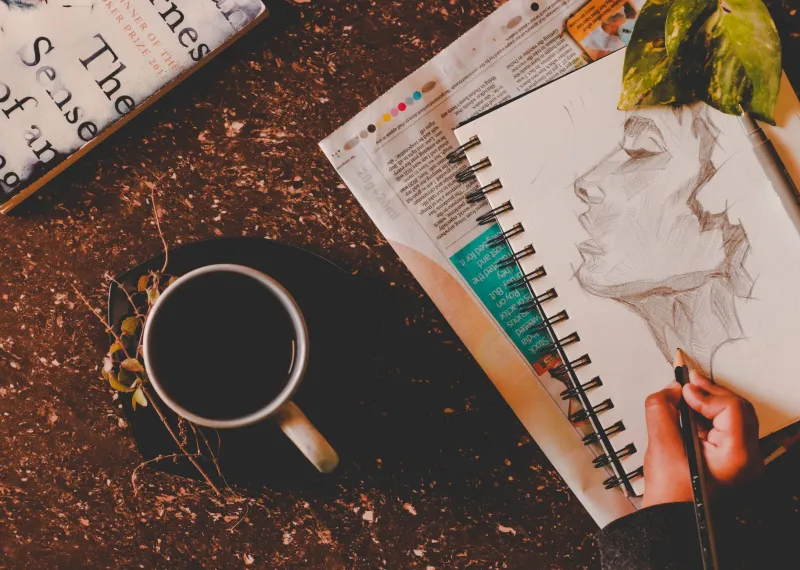
There is a particular kind of courage required to hand someone a drawing with pencil smudges still visible, the eraser ghost of a discarded line haunting the margin, and say: this is what I am selling you. Not the resolved version. Not the cleaned, matted, gallery-ready object. The thinking itself—captured mid-flight.
That courage, once considered professional naivety, has become one of the more quietly revolutionary postures in contemporary American creative culture.
The Ledger of Imperfection
For decades, the commercial logic of art-making operated on a simple premise: you concealed the labor, presented the result, and the mystique of apparent effortlessness justified the price. The finished canvas was the product precisely because it erased its own making. Galleries understood this. Collectors expected it. The studio was a private room, and the public was never invited in until everything was tidied.
That arrangement has collapsed—not suddenly, but through a slow erosion accelerated by digital transparency and a cultural appetite for authenticity that has grown sophisticated enough to distinguish the genuine article from its performed imitation.
Today, a ceramicist in Portland selling time-lapse footage of a bowl collapsing on the wheel is not offering a consolation prize. A Brooklyn-based illustrator auctioning a sketchbook of abandoned character studies is not clearing inventory. These are deliberate commercial decisions, grounded in the recognition that audiences now assign profound value to witnessing the conditions under which creation either succeeds or fails.
The Archive as Art Object
What has changed is not merely the market—it is the ontology of the art object itself. The question of what constitutes a finished work has been reopened, and the answers emerging from studios across the country are heterodox and genuinely interesting.
Consider the practice of documentation-first creation, in which the artist structures the entire making process as a kind of performance, with studio footage, annotated sketches, and even email threads between collaborators offered as tiered products. The final painting, should one exist at all, becomes almost incidental—the epilogue to a story whose earlier chapters were always the more compelling read.
This is not a phenomenon confined to emerging artists working outside institutional frameworks. Established designers have begun releasing what might be called process editions: limited runs of rejected prototypes, maquettes, and material samples that preceded a celebrated final object. The provenance these objects carry is not the history of where they have been, but of what they narrowly avoided becoming.
Transparency as Currency
The cultural conditions enabling this shift are worth examining with some precision. We are living through a prolonged reckoning with the mythology of genius—the idea that great creative work arrives whole and inevitable from some untouchable interior place. That mythology has grown increasingly untenable, and not merely because social media has made studio life visible. It has grown untenable because a generation of audiences raised on behind-the-scenes content, making-of documentaries, and the raw material of creative communities on platforms like Substack and Patreon has developed a genuine literacy for process.
They do not merely tolerate the draft. They prefer it. The draft is honest in a way the finished work, polished to remove all evidence of struggle, often cannot be.
This preference has economic consequences. When a designer's Patreon offering—monthly access to annotated work-in-progress files, voice memos recorded while problem-solving, and photographs of the studio floor at its most chaotic—generates more revenue than licensing the completed designs, the market is communicating something important about where value now resides.
The Collector's New Appetite
The shift is also reshaping collecting culture in ways that will take years to fully understand. A collector who acquires a failed prototype is not purchasing a lesser version of the finished object—they are purchasing access to a decision, to the precise moment when the artist chose a different path. That is, in many respects, a more intimate acquisition than the resolved work could ever be.
There is also a democratizing dimension worth acknowledging. Process work tends to be priced below the finished object, which has historically been the only entry point into collecting. A young collector in Chicago or Atlanta who cannot afford a painter's exhibited canvases may be able to acquire a notebook of studies that, in terms of direct access to the artist's thinking, is arguably the superior object.
The Limits of the Open Studio
It would be intellectually dishonest not to register the complications embedded in this shift. The monetization of process carries its own performance pressures. When the sketch is a product, the act of sketching becomes subject to the same commercial considerations that once governed only the finished work. The studio, opened to an audience, is no longer simply a studio.
Some artists have begun to speak candidly about the cognitive burden of maintaining a documented practice—the awareness that every discarded attempt is potential content, every moment of confusion a narrative asset. The liberation of showing the work-in-progress can curdle, under sustained commercial pressure, into a new kind of constraint.
There is also the question of what disappears when nothing is permitted to remain private. The unwitnessed failure, the experiment that goes nowhere and is quietly abandoned, may be as essential to creative development as any success. An economy that assigns value to every stage of the process risks leaving no stage unobserved—and observation, as any artist will tell you, changes what it watches.
What the Draft Reveals
None of this diminishes the genuine significance of what is happening. The willingness of artists to present incompletion as a legitimate endpoint represents a meaningful challenge to the perfectionism that has long governed creative commerce—a perfectionism that was always, to some degree, a fiction anyway.
The draft does not lie about effort. It does not conceal the false starts or smooth over the moments when the maker was genuinely lost. In a cultural moment saturated with the highly produced and the algorithmically optimized, that honesty is not a minor virtue. It is, for many, the primary one.
The unfinished canvas, it turns out, was never really unfinished. It was simply finished differently—at a point in the process we were not previously permitted to see. That we are now being invited to look, and that we are arriving with our wallets open, suggests something has shifted not just in the market for art, but in our understanding of what art is fundamentally for.